Medical Equipment Maintenance: A Practical Guide for Service Teams
November 16, 2026
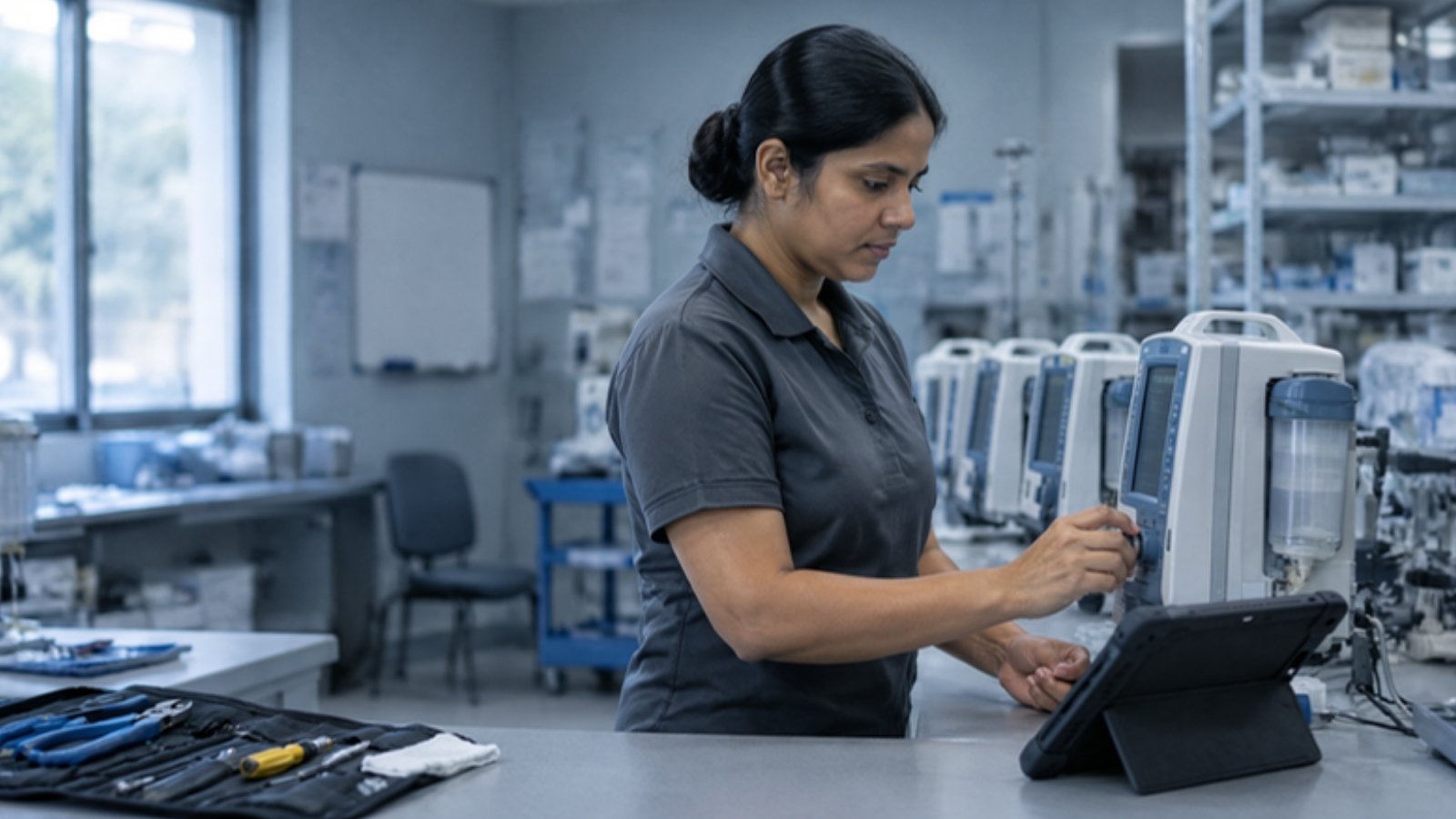
Medical equipment maintenance sounds simple until you're the one keeping a mixed fleet running: three generations of X-ray rooms, a drawer of ultrasound probes, infusion pumps from two manufacturers, and a sterilizer that only one tech really understands. This guide is for the people doing that work, whether you run an independent service company or a small OEM or in-house service team. It covers what a maintenance program has to include, where you have room to set your own schedule, and how to make the repair side faster and easier to defend.
What medical equipment maintenance actually covers
The World Health Organization's Medical equipment maintenance programme overview splits the work into three parts: inspection, preventive maintenance (PM) and corrective maintenance. Performance inspections confirm the equipment works correctly, safety inspections confirm it is safe for patients and operators, and PM aims to extend equipment life and reduce failure rates.
Most programs are strong on the first two, because they run on a calendar. Corrective maintenance is where time and money leak out. It is unplanned, it lands on whoever is free, and it depends on how quickly a tech can find the right procedure for that exact model and fault.
The stakes are real. A peer-reviewed chapter on maintenance prioritization notes that the most frequent cause of medical equipment stopping is poor maintenance, planning and management, not the equipment itself.
Step 1: Build an inventory you actually trust
Every program starts with a list, and most lists are wrong in small ways that add up. For each device, record at least:
- Manufacturer, model and serial number
- Location and owner (department or customer site)
- Software or firmware version, if it has one
- Which manual revision applies to it
- Its PM schedule and the date of its last PM
- Its risk level (more on that below)
Item 4 is the one teams skip. Two units of the same model can need different procedures because of a hardware revision or a software update. If your inventory doesn't link each device to the right manual, every corrective job starts with a search.
Step 2: Set PM by risk, and know where you can't
In the U.S., hospitals have some flexibility here. CMS memo S&C 14-07, "Hospital Equipment Maintenance Requirements" lets a hospital adjust maintenance, inspection and testing frequencies away from the manufacturer's recommendations through an Alternate Equipment Management (AEM) program, based on a risk assessment by qualified staff. The hospital has to write policies for it, keep documentation, and then follow the activities and frequencies it sets.
There are firm exceptions. The same memo says all imaging and radiologic equipment must be maintained per the manufacturer's recommendations, and medical lasers are excluded from risk-based adjustment.
What this means for a service team:
- Imaging work follows the manual. If you service X-ray, CT or similar equipment, the manufacturer's procedures and intervals are the requirement, not a suggestion. Your techs need fast access to the right section.
- Everything else needs a written rationale. If your customer runs an AEM program, ask for it. Your PM visits should match it, and your reports should show you did what it says.
- New equipment starts on the manufacturer's schedule. The memo notes exceptions where there isn't enough maintenance history yet.
Step 3: Make corrective maintenance follow the manual
The U.S. Bureau of Labor Statistics describes medical equipment repairers as people who install, maintain and repair patient care equipment, and notes they may consult technical manuals as needed. The field is growing: BLS counts about 71,800 jobs in 2025 and projects 13% growth from 2025 to 2035. More techs, more equipment and more models means more time spent finding the right procedure.
Here is a fact worth taping to the wall. In an analysis of 28 operating-room studies reported by BMJ Quality & Safety, equipment and technology problems caused 23.5% of errors, and among the studies that broke them down, configuration or settings were the problem in 43.4% of cases. Not broken parts. Settings.
That pattern shows up in repair work too. Before a tech swaps a board, they should rule out setup and configuration, in the order the manual gives. A good corrective process looks like this:
- Capture the symptom exactly. Error code, what the operator saw, when it started.
- Check the service history. Same fault last month? That changes the plan.
- Open the procedure for this model and this fault. Not the whole manual, the section that applies.
- Work the steps in order, including the configuration and calibration checks before any part swap.
- Verify the repair with the performance and safety checks the manual calls for.
- Escalate when the manual runs out. If the documented steps don't resolve it, stop and escalate. Guessing on patient care equipment is how a repair becomes an incident.
We cover the time side of this in more detail in how to reduce MTTR and how to improve first-time fix rate.
Step 4: Document every job so it holds up
If it isn't written down, it didn't happen. That applies to surveyors, to your customer's biomed manager, and to the next tech who opens the same unit.
Each job record should show what was reported, what was found, which procedure was followed (manual and section), what was replaced, how the repair was verified, and who did it. Short, required fields beat long free-text notes nobody reads.
If you need a starting point, use our field service report template. It is built for medical equipment work and is free to download.
Step 5: Decide your escalation rules before you need them
Escalation should be a rule, not a judgment call made at 6 p.m. on a Friday. Write down:
- When a tech must escalate: the documented steps are exhausted, the fault isn't in the manual, or the fix would need a deviation from the manufacturer's procedure.
- Who they escalate to: a senior engineer, the OEM's technical support, or both.
- What they send: the symptom, the steps already done, the readings, and photos.
- How the answer gets recorded, so the next tech with the same fault doesn't start from zero.
That last point is how a team gets better over time. Every escalation that gets written down becomes a known fix.
Step 6: Measure the program, not just the PM completion rate
PM completion is easy to measure and easy to hit. It tells you little about whether equipment is available when clinicians need it. Track these too:
- Mean time to repair, split into diagnose, find procedure, fix and close out
- First-time fix rate, by model and by fault
- Repeat failures within 30 days of a repair
- Downtime per device, especially for imaging, where one down room stops a whole schedule
Our guide to reducing equipment downtime has seven fixes you can start this quarter.
A quick medical equipment maintenance checklist
- Every device in the inventory is linked to the right manual revision.
- PM intervals match the manufacturer, or a written AEM risk assessment.
- Imaging and laser equipment follow the manufacturer's procedures.
- Corrective jobs start from the procedure for that model and fault.
- Configuration and calibration are checked before parts are swapped.
- Every repair is verified and documented, with the procedure cited.
- Escalation rules are written, and answers are recorded.
- You track MTTR, first-time fix and repeat failures, not just PM completion.
Where Fixr8 fits
Fixr8 handles Step 3. It turns your equipment service manuals into step-by-step guidance a tech can follow on the job, and every step cites the exact manual section it came from, so the job record can show which procedure was followed. When the manual doesn't cover a fault, Fixr8 says so and escalates instead of guessing.
It doesn't replace your CMMS, your PM schedule or your techs' judgment. If corrective work on a mixed fleet is where your team loses the most time, check whether your team is a fit or book a 30-minute demo.
Sources
- WHO: Medical equipment maintenance programme overview (2011)
- IntechOpen: A Modern Approach for Maintenance Prioritization of Medical Equipment (2020)
- CMS S&C 14-07: Hospital Equipment Maintenance Requirements
- BLS Occupational Outlook Handbook: Medical Equipment Repairers
- BMJ Quality & Safety study on operating-room equipment errors (ScienceDaily release, 2013)
Stop paying for the same repair twice.
FixR8 Field Notes: one short email a week with practical playbooks, one sourced stat, and one blunt takeaway for equipment service teams. No fluff. Unsubscribe anytime.
Opens Substack to confirm. Read past issues