Healthcare Technology Management: Where AI Helps HTM Teams
November 16, 2026
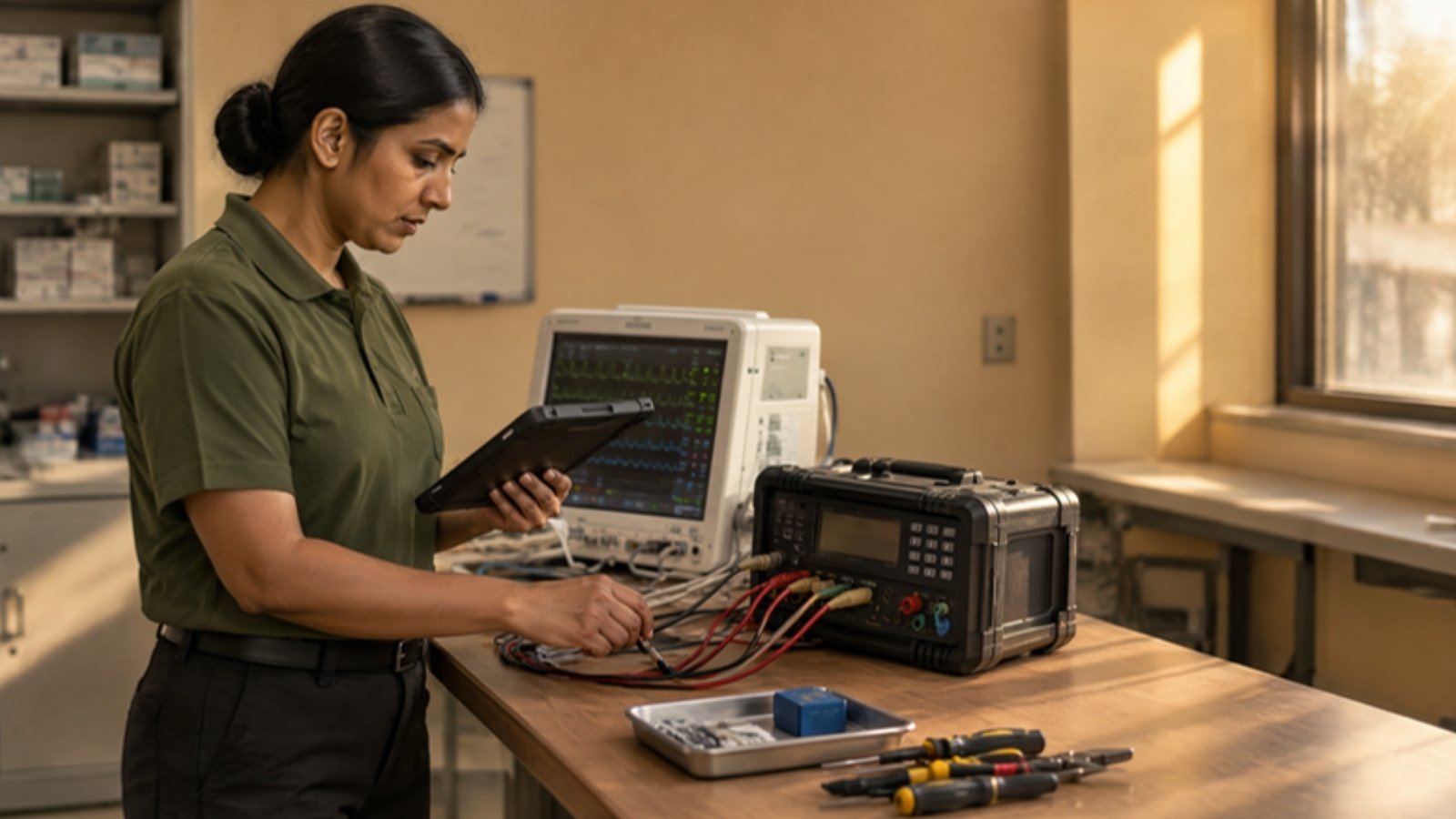
If you run an HTM department, or an independent service company that hospitals lean on, you already know the job description has outgrown the shop. Healthcare technology management now covers inventory, preventive maintenance, repairs, recalls, cybersecurity, capital planning and the records a surveyor will ask for. The people doing it are stretched, and every vendor wants to sell you "AI." This guide is for the leader trying to decide where AI actually helps an HTM team, where it gets in the way, and what to demand before you let it near a repair.
What healthcare technology management covers today
The old name was clinical or biomedical engineering. The work is still fixing devices, but it is no longer only that. A recent Stanford Medicine piece on its biomedical engineering team describes HTM moving from a "fix-it shop" to an enterprise partner: device lifecycle governance, documented service events, capital refresh planning, data integration across inventories, and helping validate new technology.
Day to day, the core is still hands-on. The U.S. Bureau of Labor Statistics lists what medical equipment repairers do: install equipment, test and calibrate it, repair and replace parts, perform preventive maintenance, keep records of maintenance and repairs, and show staff how to operate it.
That mix matters for AI. Planning and analytics work is mostly data. Repair work is mostly judgment applied to a specific device, a specific fault and a specific manual. The same tool rarely fits both.
The pressure on HTM teams
The numbers explain why leaders are looking for help:
- People are leaving. The 2025 State of HTM survey from AAMI and TechNation reports that roughly one-third of the profession is expected to retire within five years, and 21% of respondents have more than 30 years in the field.
- The work keeps coming. BLS projects employment of medical equipment repairers to grow 13% from 2025 to 2035, with about 8,200 openings a year. You will be hiring and training for years.
- Hours are already long. In the same State of HTM survey, 56% of respondents regularly work on-call.
- The rules are specific. CMS lets hospitals adjust maintenance intervals through an alternate equipment management (AEM) program, but imaging and radiologic equipment must still be maintained per the manufacturer's recommendations, and so must medical lasers and new equipment without enough maintenance history. The State of HTM survey found 57% of departments use an AEM program.
Put together: fewer experienced people, more devices, and a regulator that expects you to follow the manufacturer's documentation to the letter on some of your most expensive equipment.
How HTM teams feel about AI
They are skeptical, and that is healthy. In the State of HTM survey, 41% of respondents called AI potentially useful but overhyped, 33% an exciting opportunity, and 17% risky or concerning.
That split tracks with what you see in practice. AI that summarizes a dashboard is low risk. AI that tells a tech which board to swap on a generator is not, unless you can check where the answer came from.
Where AI helps an HTM team
Here is where AI earns its keep, ordered from lowest to highest risk.
1. Writing up the work
Service records are where techs lose time after the repair is done. AI can draft the work order notes from what the tech did: symptom, steps taken, parts used, test results, and the procedure followed. The tech reviews and signs. The WHO maintenance programme overview frames maintenance as inspection plus preventive and corrective work; a clean record of each is what makes the program defensible. If you need a structure, our field service report template shows the fields that hold up.
2. Sorting and routing work orders
Free-text tickets ("monitor beeping in 4 West") can be classified by device type, likely fault area and urgency, then routed to the right person. This saves dispatch time and does not touch the repair itself.
3. Finding the right procedure in the manual
This is often the biggest time sink on a corrective job. A tech with a fault code and a service manual that runs to hundreds of pages spends real time searching before any wrench turns. AI that reads the manual for that exact model and returns the relevant procedure, with the section and page, turns that search into a lookup. We broke down how much of a repair goes to searching in how to reduce MTTR.
For imaging equipment, this is not just convenience. If CMS expects the manufacturer's procedure, the tech needs that procedure, not a summary from somewhere else.
4. Getting a newer tech through an unfamiliar device
With a third of the field near retirement, junior techs will meet devices they have never opened. Step-by-step guidance pulled from the manual, one step at a time, lets them work while a senior engineer is on another call. It also means more jobs get finished on the first visit, which we covered in how to improve first-time fix rate.
Where AI gets in the way
AI hurts an HTM team when it answers without a source. A general chatbot will produce a confident procedure for a device it has never seen documentation for. On a ventilator, an X-ray generator or an infusion pump, a plausible guess is worse than no answer.
It also gets in the way when it changes decisions that belong to qualified people. AEM risk assessments, decisions to pull a device from service, and recall responses need a human who signs their name to them. AI can gather the facts. It should not make the call.
What to demand before you trust AI on a repair
Use this checklist when you evaluate any tool:
- Every answer cites the manual. Section, page or procedure number, so the tech can check it in seconds.
- It says when the manual doesn't cover it. "Not in the documentation, escalate" is the right answer, not a guess.
- It escalates cleanly. The unresolved fault goes to a senior engineer or the OEM with the steps already tried.
- It works from your manuals, for your models. Not general internet knowledge about "X-ray machines."
- It leaves a record. Which procedure was followed, which steps were done, what the result was.
- It keeps patient data out. Repair guidance doesn't need it; don't feed it any.
We go deeper on what AI can and can't do for service teams in field service AI for equipment service teams, and on building the wider program in our medical equipment maintenance guide.
A simple way to start
- Pick one device family that causes the most repeat calls or the longest repairs.
- Gather the current service manuals for those exact models.
- Run a 30-day trial on corrective jobs only, with the checklist above.
- Measure time to find the procedure, repair time and repeat visits before and after.
- Keep what saves time and holds up to your documentation standard; drop the rest.
Where Fixr8 fits
Fixr8 turns your equipment service manuals into step-by-step guidance your techs follow on the job. Every answer cites the exact manual section, and when the manual doesn't cover a fault, Fixr8 says so and escalates instead of guessing. It is built for the repair itself, not for scheduling or asset dashboards.
If your HTM team or service company is short on senior engineers and long on manuals, check whether your team is a fit or book a 30-minute demo to see it on a real manual.
Sources
- Stanford Medicine TDS: From fix-it shop to enterprise partner, the new face of biomedical engineering
- U.S. Bureau of Labor Statistics: Medical Equipment Repairers, Occupational Outlook Handbook
- TechNation: The State of HTM: Insights, Impact & What's Next (AAMI & TechNation 2025 State of HTM Survey)
- CMS S&C 14-07: Hospital Equipment Maintenance Requirements
- WHO: Medical equipment maintenance programme overview
Stop paying for the same repair twice.
FixR8 Field Notes: one short email a week with practical playbooks, one sourced stat, and one blunt takeaway for equipment service teams. No fluff. Unsubscribe anytime.
Opens Substack to confirm. Read past issues