Medical Device Preventive Maintenance: How to Set Intervals That Hold Up
November 20, 2026
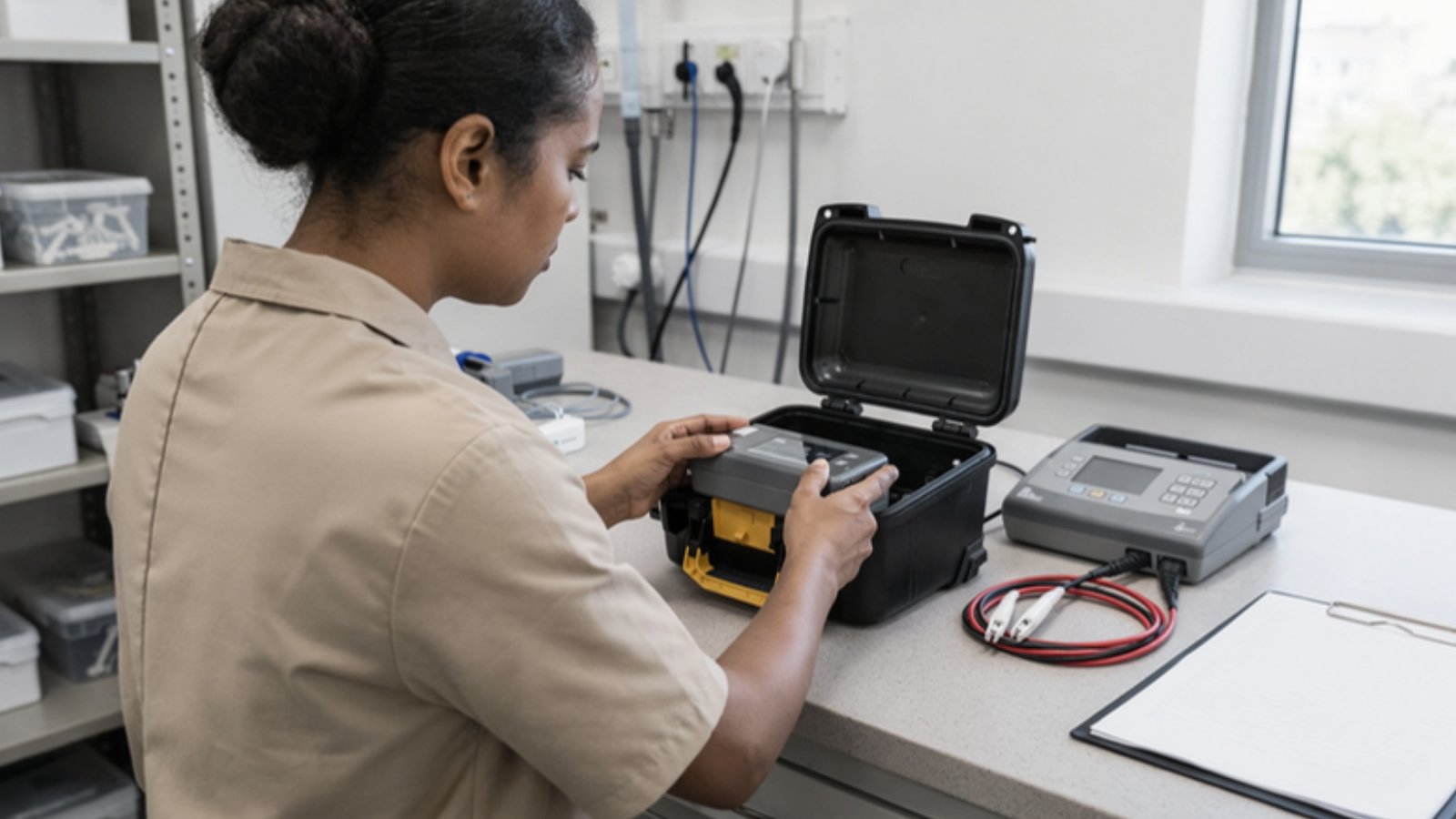
Most medical device preventive maintenance schedules were never really designed. Someone copied the manufacturer's interval into the CMMS years ago, added "annual" to everything else, and the calendar has run the team ever since. That works until you have more devices than technician hours, and then you need to know which intervals you can stretch, which you must tighten, and which you are not allowed to touch.
This guide is for service managers at independent service organizations and small OEM service teams who own PM schedules for a customer's fleet. It covers how to set intervals that hold up: to an auditor, to a failure log, and to a technician who has to actually do the work.
What preventive maintenance is (and what it isn't)
The WHO splits a maintenance program into three kinds of work. Its maintenance programme overview describes performance inspections that confirm equipment is operating correctly, safety inspections that confirm it is safe for patients and operators, and preventive maintenance that "aims to extend the life of the equipment and reduce failure rates."
Keep those separate in your schedule. An electrical safety test, a performance check against an analyzer and a parts replacement (batteries, filters, seals) are different tasks with different intervals. Lumping them into one "PM" line is how teams end up replacing parts too often on some devices and missing inspections on others.
Corrective maintenance, the repair after something fails, sits outside the PM schedule. But as you'll see below, the two feed each other.
Know the rules before you change a medical device preventive maintenance interval
In the US, hospitals that participate in Medicare follow CMS guidance on equipment maintenance. Your customers will ask whether your schedule complies, so you need to know it too.
CMS memo S&C 14-07 says a hospital may adjust maintenance, inspection and testing frequency from what the manufacturer recommends, "based on a risk-based assessment by qualified personnel." That is the Alternate Equipment Management (AEM) program. There are hard exceptions. The memo says the manufacturer's recommendations apply when:
- Other federal or state law, or the hospital Conditions of Participation, require them. The memo's example: all imaging and radiologic equipment must be maintained per the manufacturer's recommendations.
- The equipment is a medical laser.
- The equipment is new and doesn't have enough maintenance history yet.
Hospitals that do use AEM must write policies and procedures, keep documentation supporting the program, and "adhere strictly" to the frequencies they set. In practice that means two things for a service team:
- Imaging, lasers and new equipment: follow the manufacturer's schedule. Your job is to find it, put it in the schedule exactly, and prove you did it.
- Everything else in an AEM program: the interval is a documented decision. Once it is set, a missed PM is a missed commitment, not a scheduling slip.
Step 1: Start every device at the manufacturer's interval
Pull the recommended interval and task list from the manufacturer's service documentation for each model, not a generic template. Record where it came from (document, revision, section) next to the interval in your CMMS.
This sounds obvious. It's often skipped because the manual is a long PDF and the interval is buried in a maintenance chapter. But it's the baseline every later decision is measured against. If you can't show the manufacturer's number, you can't defend a different one.
For older equipment the manual may not exist. That's a real case, not an edge case: in a 2016 study of 723 high-risk devices at Istanbul University's medical faculty, the author split the fleet into two groups partly because many older devices lacked service or user manuals, and with them the manufacturer's recommendations. Those devices needed a different way to set intervals.
Step 2: Score risk when there's no usable recommendation
The common method is the Equipment Management Number (EMN), from Fennigkoh and Smith. The same study describes it: add a function score, a risk score and a maintenance-requirement score. The maximum is 20. In that study, devices scoring 12 or higher went into the annual inspection plan, and devices above 17 were checked every 6 months.
How it played out there:
| Device | EMN | Inspection interval | |---|---|---| | ECG | 14 | 12 months | | Aspirator | 16 | 12 months | | Phototherapy unit | 17 | 6 months | | Electrosurgical unit | 19 | 6 months | | Defibrillator | 20 | 6 months | | Infant incubator | 20 | 6 months |
Use the score to set a starting interval, not a permanent one. Risk scoring tells you how bad a failure would be. It doesn't tell you how often a given model actually fails in your customer's building. Only your own data does.
Step 3: Let failure data move the interval
This is where most schedules stall. The point of running inspections is to learn something, and the most useful thing you learn is which devices fail between visits.
In the Istanbul study, inspections of the 589 older devices found failures in 126 of them (22%); the other 463 (78%) passed. Most of the failures were hidden: devices still running, but out of spec. Sphygmomanometers with pressure leaks. Defibrillators with low batteries or sync errors. Electrosurgical units with power faults. The team then planned PM from those results. Equipment with recorded failures got a more frequent schedule, and incubators got a 3-month maintenance interval for their most common hidden failures.
After six months, the pilot devices (defibrillators and electrosurgical units) were tested again, and fewer failures turned up than before preventive maintenance.
You can run the same loop:
- Record every inspection result as pass/fail with the failure named, not just "PM done." A structured field service report makes this automatic.
- Review failures by model every quarter. A model that keeps failing between PMs needs a shorter interval or a different task list (for example, replacing the battery on a schedule instead of testing it).
- Lengthen intervals only with history. A model that passes inspection after inspection may be a candidate for a longer interval under AEM, but only outside the CMS exceptions, only with documented reasoning, and only after enough history.
- Write down every change. Old interval, new interval, the data behind it, who approved it, and the date.
Step 4: Plan for the PM that finds a problem
A PM that passes takes the time on the schedule. A PM that fails turns into a repair, and that's where your schedule actually breaks.
In the same study, the hospital's biomedical staff fixed most hidden failures during preventive maintenance. But sync problems on two defibrillators couldn't be resolved in-house and went to the manufacturer's technical service. That's the normal shape of PM work: most findings are routine, and a few need someone who knows that exact model.
So for each device type on your schedule, decide ahead of time:
- What the tech does on the spot. Which failures they fix during the PM visit, with which parts on the truck.
- Where the procedure comes from. The corrective steps for that model's common faults, from the manufacturer's service manual, reachable on site without hunting through a PDF.
- When they escalate. Which faults go to a senior engineer or the OEM, and how fast.
That planning is what keeps a failed PM from becoming a second visit. If repeat visits are already a problem, our guide to improving first-time fix rate covers the rest.
Step 5: Make the schedule survive staff turnover
Intervals that live in one senior engineer's head don't hold up. The Bureau of Labor Statistics projects about 8,200 openings for medical equipment repairers each year on average over the decade, many from workers who retire or change occupations. New techs will be doing your PMs.
Give them what they need to do the work the same way every time:
- A task list per model, tied to the manufacturer's procedure, not a generic checklist.
- Pass/fail criteria with numbers, so "within spec" means the same thing to everyone.
- The reason for the interval, so nobody quietly changes it.
For the bigger picture on running a program, see our medical equipment maintenance guide.
A quick checklist for medical device PM intervals
- Manufacturer interval recorded, with document and section, for every model.
- Imaging, lasers and new equipment locked to the manufacturer's schedule.
- Risk score used as the starting point where no recommendation exists.
- Every inspection logged as pass/fail with the failure named.
- Quarterly failure review by model.
- Every interval change documented with data and approval.
- A plan for what happens when a PM finds a fault.
Where Fixr8 fits
Fixr8 doesn't set your PM intervals. That decision belongs to your team and your customer's risk assessment. Where it helps is the moment a PM finds a fault: Fixr8 turns the equipment's service manual into step-by-step guidance the technician follows on site, and every step cites the exact manual section, so the corrective work matches what the manufacturer documented. When the manual doesn't cover the fault, it says so and escalates instead of guessing.
If your techs spend PM visits hunting through manuals for the fix, check whether your team is a fit or book a 30-minute demo.
Sources
Stop paying for the same repair twice.
FixR8 Field Notes: one short email a week with practical playbooks, one sourced stat, and one blunt takeaway for equipment service teams. No fluff. Unsubscribe anytime.
Opens Substack to confirm. Read past issues